
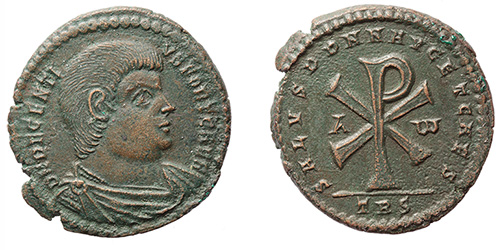
The Christogram is a monogram that exists in several variants. It is composed of the two Greek letter "chi" and "rho" that are the first two letters in the Greek "Christos" or "Christ." Its Christian origin dates to the Battle of the Milvian bridge in 312 where Constantine was reported to have seen this symbol in a vision prior to the battle. He then added it to his standards and shields to assure his victory. It subsequently began appearing on coins for Constantine and his successors.
(2 coins)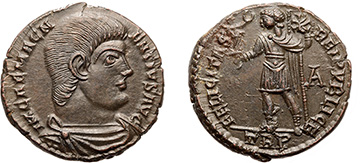
56420
Add to Cart Magentius, 350-353 A.D.
AE Follis or Maiorina, 5.29g. 22mm. Trier mint. IM CAE MAGNENTIVS AVG. Draped and cuirassed bust of Magnentius to right. Rev. FELICITAS REIPVBLICAE; A in field to right; TRP in exergue. Emperor standing to left holding Victory and labarum emblazoned with a Christogram. RIC VIII,264. Bastien 24. Attractive brown patina and nearly as struck. Provenance/Pedigree: Extremely Fine $750. |
58076
Add to Cart Decentius, 351-353 A.D.
AE Double Maiorina, 7.97g. 28mm. Trier mint. D N DECENTIVS FORT CAES. Bare-headed, draped, and cuirassed bust of Decentius to right. Rev. SALVS DD NN AVG ET CAES; TRS in exergue. Large Christogram flanked by "alpha" and "omega". RIC 319. Bastien 87. Reddish-brown patina. This issue with the christogram for Decentius is much rarer than the corresponding one for Magnentius. Provenance/Pedigrees: about Extremely Fine/Extremely Fine $2,000. |


